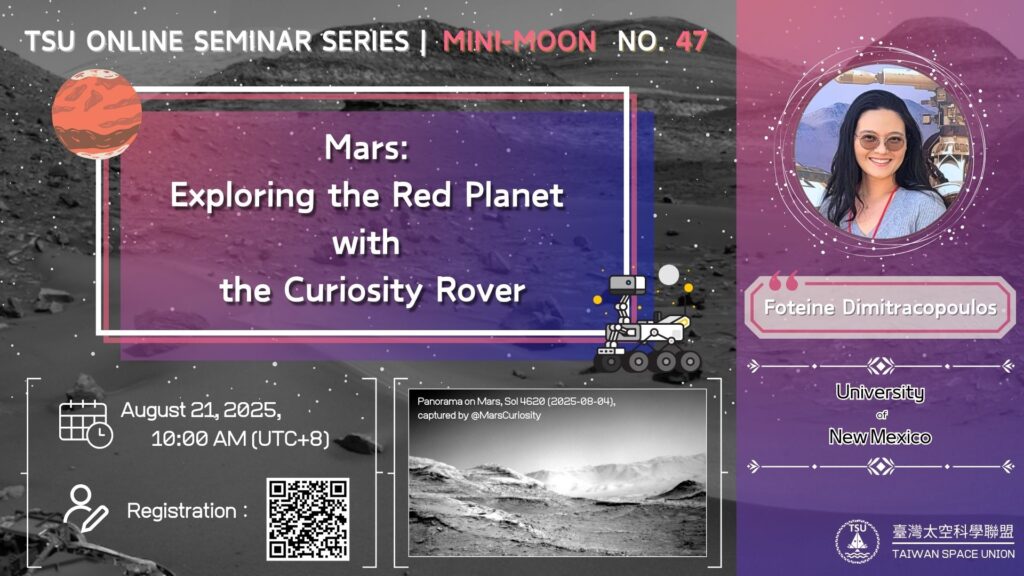
★ August 21, 2025 (Thursday) 10:00 AM (UTC+8)
Speaker: Foteine Dimitracopoulos ( University of New Mexico )
Title: Mars: Exploring the Red Planet with the Curiosity Rover
Abstract
As one of our closest terrestrial neighbors in the Solar System, Mars has played a significant role in culture and scientific discoveries for much of human history. Now, it is a place of great interest to planetary scientists and astrobiologists alike, seeking to answer questions on topics ranging from the formation of the Solar System to the possibility of life and past habitability. Multiple exploration missions have been sent to Mars, including orbiters and rovers. One of several significant missions to the red planet is the Mars Science Laboratory (MSL) Curiosity rover, which landed in 2012 in a crater with a central mound – Gale crater. Orbital and in-situ observations confirmed the presence of an ancient lake in Gale crater, further supporting evidence for a wet climate on ancient Mars.
Since Curiosity landed on Mars thirteen years ago, many fascinating discoveries have been made with the ten scientific instruments onboard the rover. This talk will focus on the Chemistry and Camera (ChemCam) instrument onboard Curiosity, which is capable of obtaining high-resolution images of targets and chemical composition with the versatile Laser-Induced Breakdown Spectroscopy (LIBS) technique. Rover exploration is highly useful and insightful; coupled with LIBS techniques, we will be able to explore and improve our understanding of vastly different environments on objects in our Solar System.
Video
Foteine Dimitracopoulos
Bio
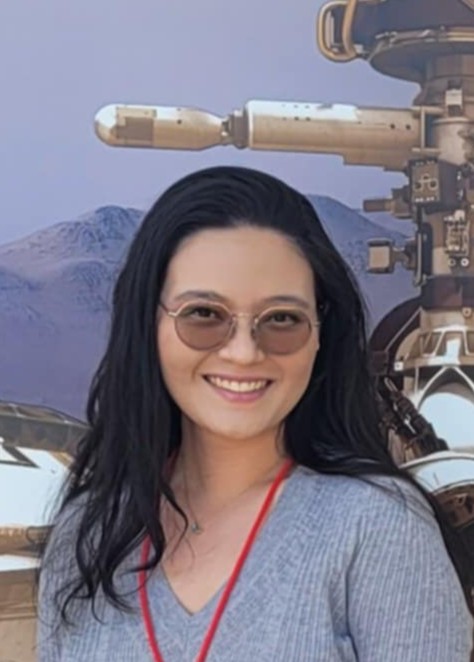
Foteine Dimitracopoulos is a Greek-Taiwanese PhD student at the University of New Mexico. She received her B.S. in Geology from the University of Maryland, College Park in USA, followed by her M.S. in Petroleum Engineering at the Technical University of Crete in Chania, Greece. Since 2020, she has been a member of the Mars Science Laboratory (MSL) Curiosity Rover’s ChemCam team and participates in rover operations including downlink reports on science targets.
Her current work involves calibrating Laser-Induced Breakdown Spectroscopy (LIBS) for the ChemCam instrument on Mars using test bench models located at Los Alamos National Laboratory in New Mexico, USA, and at the Institut de Recherche en Astrophysique et Planétologie in Toulouse, France. Her other research interests include geochemistry, geomorphology, and surface processes on terrestrial planets and icy satellites.