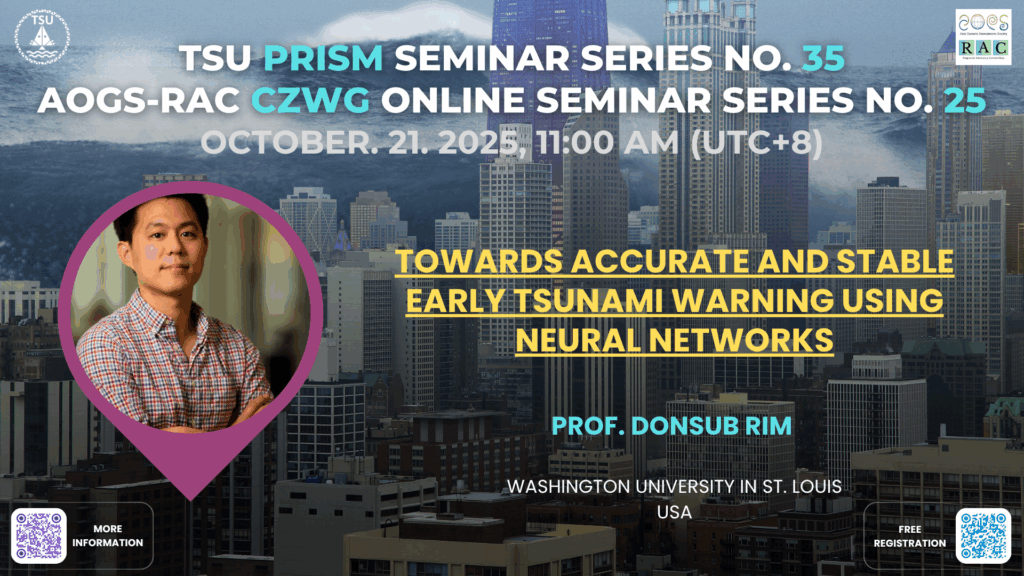
Date: October 21, 2025, 11:00 AM (UTC+8)
Speaker: Prof. Donsub Rim
Title: Towards accurate and stable early tsunami warning using neural networks

Biography
Donsub Rim is an Assistant Professor in the Department of Mathematics and Statistics at Washington University in St. Louis, USA. He received his Ph.D. in Applied Mathematics from the University of Washington in 2017 under the supervision of Randall J. LeVeque and Gunther Uhlmann. Before joining Washington University, he was a Chu Assistant Professor at Columbia University, and later a Postdoctoral Associate at the Courant Institute of Mathematical Sciences, New York University. He also served as a Visiting Assistant Professor at Tohoku University in Japan and the University of Washington.
Dr. Rim’s research focuses on the numerical analysis of partial differential equations (PDEs), model reduction of nonlinear hyperbolic systems, and machine learning for scientific computing. His work integrates low-rank neural representations, stability analysis of neural networks, and Approximate Discrete Radon Transform (ADRT) techniques to improve computational efficiency and interpretability in complex physical simulations. His research has applications in geophysics, medical imaging, and plasma physics, including tsunami early warning and hazard assessment, storm surge prediction, and diffusion magnetic resonance imaging (dMRI).
In addition to developing novel mathematical and computational frameworks, Dr. Rim actively collaborates across disciplines to apply advanced numerical models to real-world disaster forecasting and risk mitigation. His recent works include the use of neural networks for tsunami early warning systems, published in J. Geophysical Research: Machine Learning and Computation (2024), and the development of ADRT-based algorithms for fast and accurate data inversion.
Abstract
Feedforward neural networks (NNs) have remarkable potential to serve as fast and accurate prediction models in many high-consequence applications. In particular, they can be straightforwardly applied to the tsunami early warning problem. Using only 4–8 minutes of geodetic measurements of the earthquake at various GNSS stations, one can train a NN to predict the full tsunami waveform for a 6-hour period at nearshore gauge locations. However, current NN models are not yet suitable for deployment in practice, since they are known to be unstable with respect to input perturbations called adversarial examples. The focus of this talk is the analysis of these instabilities. We will introduce the low-rank Householder expansion (LRHE) of NNs, a certain linearization of the NN about an input, and discuss computational experiments illustrating a close relationship between the low-rank structure revealed by LRHE and the adversarial examples.
This talk is based on joint works with Robert Baraldi, Sanghyun Hong, Kookjin Lee, Randall J. LeVeque, Chris M. Liu, Sanah Suri, and Kenjiro Terada.