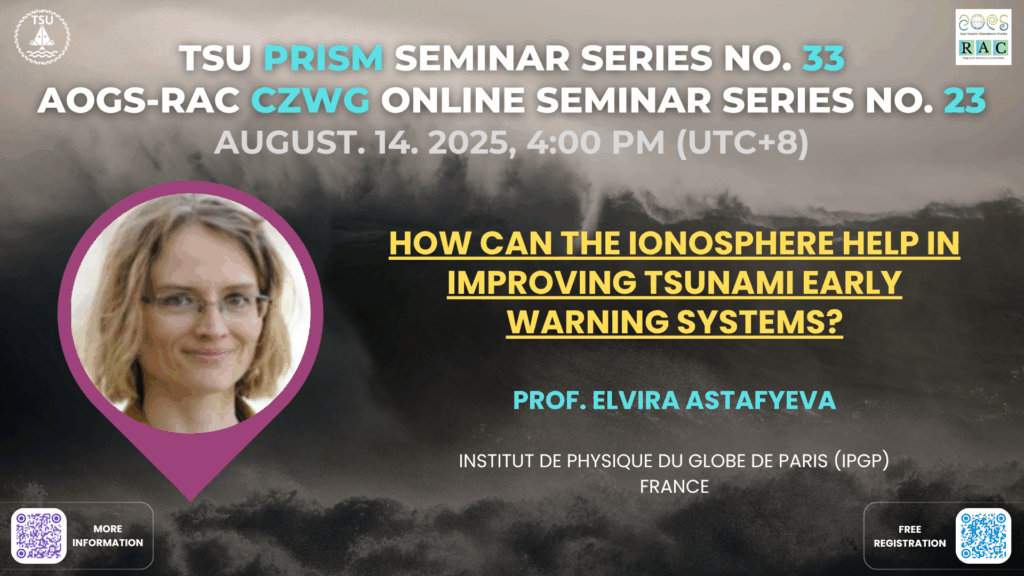
Date: August 14, 2025, 4:00 PM (UTC+8)
Speaker: Prof. Elvira Astafyeva
Title: How can the ionosphere help in improving tsunami early warning systems?
Biography
Elena Astafyeva is a Research Director at the Institut de Physique du Globe de Paris (IPGP), where she leads the Ionospheric and Seismological Studies Group. She earned her Ph.D. in geophysics from the University of Toulouse in 2008. Following her doctoral studies, she held a postdoctoral position at the Earthquake Research Institute, University of Tokyo, before joining CNRS-IPGP in 2011. Her research lies at the intersection of ionospheric physics, seismology, and space geodesy, focusing on the ionospheric signatures of large earthquakes, tsunamis, and volcanic eruptions. By combining multi-instrument satellite and ground-based observations with numerical modeling, she investigates how solid Earth events impact the ionosphere. Dr. Astafyeva has contributed significantly to advancing the use of GNSS-based ionospheric monitoring as a tool for studying geophysical hazards, and she has led several international projects in this domain.
Abstract
Nowadays, the near-real-time (NRT) monitoring and prediction of tsunami propagation in both near-field (<500 km from the source) and far-field (>500 km away from the source and trans-ocean propagation) remain very challenging. The modern tsunami forecasts rely on 1) real-time and NRT estimation of earthquake magnitude from seismic data; 2) NRT estimation of the seismic source extent and the amplitude of the co-seismic crustal uplift, and 3) monitoring of tsunami propagation in NRT. The seismic source parameters can be rapidly estimated in NRT by using data from ground-based seismometers, accelerometers and Global Navigation Satellite Systems (GNSS)-receivers. However, even the most advanced seismo-geodetic methods still fail to correctly estimate the tsunami potential for large EQs (Mw>8) in real-time.
To resolve this fundamental challenge, an ionosphere-based approach has been suggested as an alternative or/and complimentary to the “classic” methods. The ionosphere is a part the Earth’s atmosphere with the maximum of ionization located at 200-400 km of altitude. However, despite being high above the surface, the ionosphere is responsive to surface events such as natural hazards, explosions, rocket launches, etc. Earthquakes and tsunamis generate acoustic and gravity waves that propagate upward and trigger ionospheric perturbations that are often called co-seismic and co-tsunamic ionospheric disturbances (CSID and CTID, respectively). Such ionospheric disturbances carry the information about the source that generated them. Consequently, we can use ionospheric measurements in order to reconstruct information about the source. However, up to now there are no seismo-ionospheric methods that can perform in NRT.
Since 2022, in collaboration between several research institutes in France, Italy, Norway and Brazil, we are developing a GNSS-observation-based European system for earthquake and tsunami risk assessment “GO-EUREKA”. GO-EUREKA will use quasi-continuous observations of GNSS-based ionospheric total electron content (TEC) from ground-based and ship-based dual-frequency GNSS-receivers in order to assess earthquake and tsunami related hazards.
This presentation will focus on recent advances in the area of ionospheric detection of earthquakes and tsunamis, and on new developments for NRT tsunami risk assessment from the ionosphere.