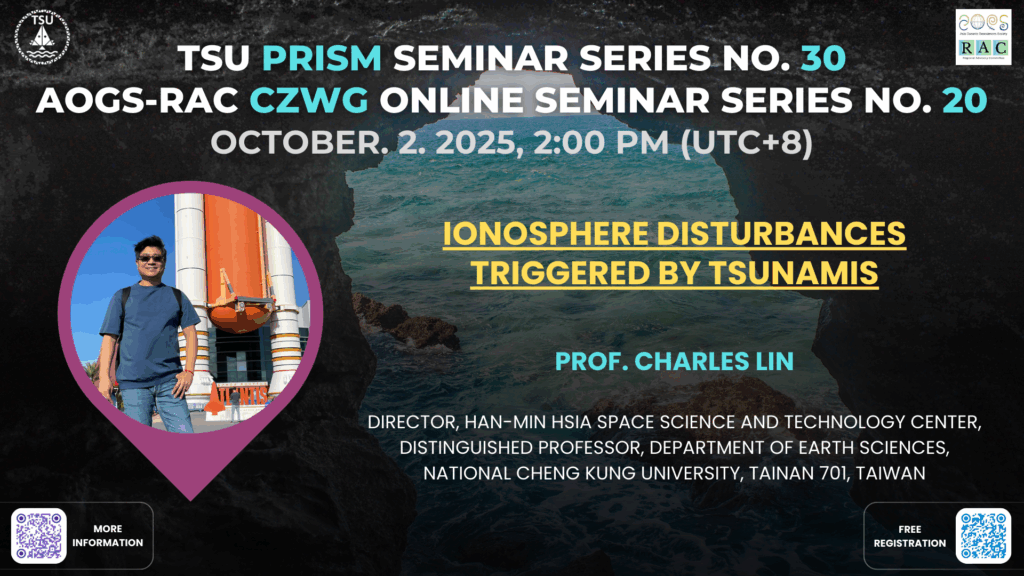
Date: October 2, 2025, 2:00 PM (UTC+8)
Speaker: Prof. Charles Lin
Title: Ionosphere Disturbances Triggered by Tsunamis 地震海嘯觸發的電離層擾動觀測

Biography
Charles Lin is the Director of the Han-Min Hsia Space Science and Technology Center and a Distinguished Professor in the Department of Earth Sciences at National Cheng Kung University (NCKU), Taiwan.
His research focuses on space weather, ionospheric physics, and satellite geosciences. He has played leading roles in Taiwan’s major space missions, including FORMOSAT-3/COSMIC, FORMOSAT-7/COSMIC-2, and the upcoming FORMOSAT-8 and FORMOSAT-9. His work involves ionospheric airglow, GNSS radio occultation, and space weather data retrieval.
Professor Lin has served as Section Secretary for the Solar-Terrestrial sciences at the Asia Oceania Geoscience Society (2019–2024), and as editor for journals such as Geoscience Letters and Journal of Astronomy and Space Sciences. He also contributes to national space development through the Taiwan Space Union and various science committees.
He has received multiple research awards, including the Kwoh-Ting Li Honorary Researcher Award (2021) and Outstanding Research Awards from Taiwan’s Ministry of Science and Technology. With over 130 publications and more than 6,500 citations, Professor Lin continues to drive Taiwan’s leadership in space science.
Abstract
The signals of earthquake, tsunami and volcano eruption could be seen from the space by utilizing the GNSS observations of the traveling ionospheric disturbances (TIDs). The signals from these lithospheric hazard could be separated from the TIDs driven by the space weather events as well as atmosphere-ionosphere vertical coupling effects with further detailed analyses. In this presentation, we will show TIDs from solar flare, magnetic storm, deep convective weather systems followed by the TIDs driven by earthquake, tsunami and volcano events for distinguishments of their differences in characteristics. Example earthquake events are 1999 Chi-chi and 2003 Hokkiado earthquakes, and tsunamis are from 2004 Sumatra and 2011 Tohoku earthquakes. Global effects driven by the 2022 Tonga volcano eruption is also addressed. These results are mainly taken from ground based GNSS observations but the characteristic will be helpful for future observations from satellite constellations.