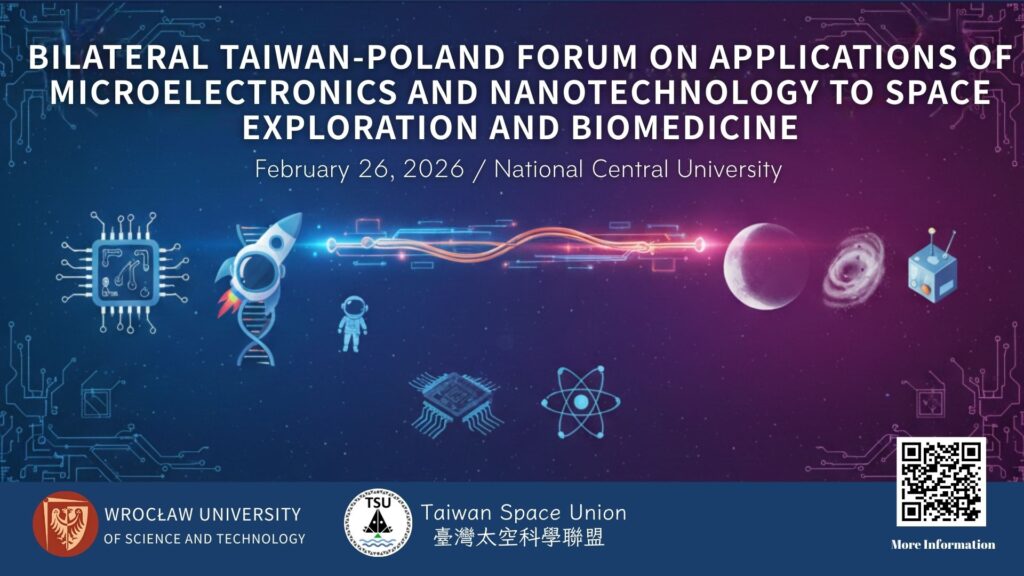
Bilateral Taiwan-Poland Forum on Applications of Microelectronics and Nanotechnology to Space Exploration  and Biomedicine

posted in: Uncategorized | 0

Date: February 26, 2026 08:30 AM (UTC+8)
Venue: Room S4-209 (2F), Science Building 4, National Central University (Google Map)
Format: In-person only (No online streaming)


On the occasion of the visit of Prof. Jan Dziuban, Prof. Rafał Walczak, Prof. Hanna Rothkaehl and Assistant Prof. Agnieszka Krakos of the Wrocław University of Science and Technology, Poland, a scientific forum covering space applications of microelectronics and nanotechnology ranging from biomedical cubesat platform, lab-on-a chip, organ-on-a chip, drug discovery, and miniaturized plasma experiments for lunar and Mars explorations is organized to promote information exchange and scientific cooperation. All are welcome!


Polish Delegation & Guests

Prof. Hanna Rothkaehl — Space Research Centre, Polish Academy of Sciences (CBK PAN)
Prof. Jan Dziuban — Wrocław University of Science and Technology (WUST)
Prof. Rafał Walczak — Wrocław University of Science and Technology (WUST)
Prof. Agnieszka Krakos — Wrocław University of Science and Technology (WUST)


Agenda

Time Topic & Speaker
08:30-09:00 Registration
09:00-09:05 Welcome
Chair: Tiger Liu
09:05-09:30 Space Science and Technology Developments at National Central University
Prof. Loren Chang / National Central University, Taiwan  [View Profile]
09:30-09:55 Faculty of Electronics, Photonics and Microsystems, WUST – from nano and microengineering to space technology
Prof. Rafał Walczak / Wrocław University of Science and Technology, Poland  [View Profile] | ResearchGate
09:55-10:20 Subminiature instruments for space applications developed at WUST: Introduction, Review of basic solutions, Space solutions, Final remarks
Prof. Jan Dziuban / Wrocław University of Science and Technology, Poland  [View Profile]
10:20-10:45 An overview of Space Plasma Division activity in SRC PAS
Prof. Hanna Rothkaehl / Space Research Centre, Polish Academy of Sciences, Poland  [View Profile]
10:45-11:00 Break
Chair: Tiger Liu
11:00-11:20 Science Payload Development – from AIP to CIP
Prof. Chi-Kuang Chao / National Central University, Taiwan  [View Profile]
11:20-11:35 The Science Payload of FORMOSAT-8C – Multiple Particle Analyzer
Yi-Yu Li / National Cheng Kung University, Taiwan  [View Profile]
11:35-11:50 Environmental Near Moon Surface Diagnostics
Prof. Hanna Rothkaehl / Space Research Centre, Polish Academy of Sciences, Poland  [View Profile]
11:50-12:05 Miniature instruments for small lunar robot: Principles, Realizations, To be done, Conclusions
Prof. Jan Dziuban / Wrocław University of Science and Technology, Poland  [View Profile]
12:05-12:20 Magnetic Field Measurements for Taiwan’s Lunar Lander Mission
Prof. Ya-Hui Yang / National Central University, Taiwan  [View Profile]
12:20-12:35 All-Sky Electrostatic Analyzer for Lunar surface exploration
Cheng-Tien Chen / National Cheng Kung University, Taiwan  [View Profile]
12:35-12:50 A Student-Driven CubeSat Mission Concept: Analyzing Lunar Ionospheric Occultation and Radiation
Yi-Yu Chang / National Central University, Taiwan  [View Profile]
12:50-14:00 Lunch break
Chair: Wing Ip
14:00-14:25 Lab-on-chip instruments – new perspectives for microgravitional biomedical research in space
Prof. Agnieszka Krakos / Wrocław University of Science and Technology, Poland  [View Profile]
14:25-14:45 From Space Manufacturing to Biomedical Applications
Prof. Jui-Jen Chang / China Medical University, Taiwan  [View Profile]
14:45-15:05 Integrating Microfluidics and Microgravity for Advanced Biological Studies
Prof. Bor-Ran Li / National Yang Ming Chiao Tung University, Taiwan  [View Profile]
15:05-15:25 Single-Molecule Approaches to Explore Space Biomedical Research
Prof. Fan-Ching Chien / National Central University, Taiwan  [View Profile]
15:25-15:40 Lab-on-chip- based laboratory for microgravitional oncological research – are we there yet?
Prof. Agnieszka Krakos / Wrocław University of Science and Technology, Poland  [View Profile]
15:40-16:00 Break
Chair: Wing Ip
16:00-16:20 Muscle-on-a-chip platform
Prof. Chia-Wen Tsao / National Central University, Taiwan  [View Profile]
16:20-16:40 Radiation Tolerance of Space Electronics for CubeSat Missions: Research Activities at NTU RTRC
Prof. Hsin-Shu Chen / National Taiwan University, Taiwan  [View Profile]
16:40-17:00 Design and Ongoing Development of a CubeSat Optical Communication Payload
Prof. Te-Yuan Chung / National Central University, Taiwan  [View Profile]
17:00-17:20 Autonomous Climbing Robots and Edge Intelligence for Structural Inspection in Extreme Environments
Prof. Tzu-Hsuan Lin / National Central University, Taiwan  [View Profile]
17:20-18:00 Discussion
Rafal Walzak, Jan Dziuban, Hanna Rothkaehl, Agnieszka Krakos
Tiger Liu, Chi-Kuang Chao, Ya-Hui Yang, Loren Chang
Jui-Jen Chang, Hsin-Shu Chen, Bor-Ran Li, Te-Yuan Chung
Fan-Ching Chien, Chia-Wen Tsao, Tzu-Hsuan Lin

Abstracts

Morning Sessions: Satellite Payloads & Lunar Exploration Technology

In this presentation, I will provide a brief review on the development of space science and engineering capacity at National Central University (NCU) starting from its inception oriented around space and upper atmospheric physics in the 1960s, supporting space mission and scientific payload design in the 1990s, to its modern incarnation with programs oriented around both space science and space systems engineering. I will also introduce current projects that may be of joint interest, including small satellite system engineering, deep space exploration with commercial lunar payload service providers, as well as industry collaborations on spacecraft subsystems and radiation tolerant electronics. It is hoped that these will serve as a base for future bilateral collaborations.

Abstract will be available soon.

Abstract will be available soon.

Space Research Centre in Warsaw, Centrum Badań Kosmicznych Polskiej Akademii Nauk (CBK PAN) is the leading Polish research institution entirely dedicated to space science and technology. With contributions to more than 70 space missions, CBK PAN develops scientific instruments and spacecraft subsystems, conducts planetary and Earth geophysical studies, and operates ground-based facilities including ionosondes, riometers, GPS scintillation monitors, and the PL610 stationof the Low-Frequency Array (LOFAR).

The plasma flows triggered by the global Earth’s circuit system changes, and electron density enhancements caused by ionisation processes, can affect modern communication and navigation technologies and also can be used for different types of services and application tools used by defence. The development of new techniques and instruments in recent years, such as LOFAR and satellite in-situ missions, significantly impacted the possibilities to study the variability of the near Earth’s environment at different temporal and spatial scales. 

Space Plasma  Division are involved in the studies modelling the plasma environment beginning from termosphere ionosphere, magnetosphere and also other Solar system bodies, as well as preparing the space mission with the contribution of space plasma diagnostics instruments.

Particularly, the activity is focusing on;
– physics of planetary magnetospheres, moons, and small bodies (with ongoing involvement in ESA missions JUICE and Comet Interceptor
– Earth’s ionosphere and magnetosphere, including electromagnetic emissions, auroral plasma dynamics, and currents;- radio diagnostics of the solar system using in-situ measurements and the LOFAR infrastructure;
– space weather and its effects on trans-ionospheric propagation, satellite operations, and ground infrastructure;
– cosmic radiation and related phenomena.

On the ground-based front, amongst others, the group was involved in the Horizon 2020 LOFAR4SW project for operational space-weather monitoring and contributes to the PITHIA-NRF initiative, a European distributed network integrating observing facilities, data processing tools, and prediction models for ionosphere, thermosphere, and plasmasphere research, as well as ESA SSA/SWE activities.

The presentation will provide an overview of our activity and outline the scope and scope of cooperation with Prof. Jann-Yenq Liu’s group at National Central University in Taiwan.

Advanced Ionospheric Probe (AIP) was an all-in-one plasma sensor that measures ionospheric plasma concentrations, velocities, and temperatures in a time-sharing way and is capable of measuring ionospheric plasma irregularities at a sample rate up to 8,192 Hz over a wide range of spatial scales. It was developed for FORMOSAt-5 satellite to explore space weather/climate and seismic precursors associated with strong earthquakes. The FORMOSAT-5, was launched by a SpaceX Falcon 9 launch vehicle from Vandenberg Air Force Base Space Launch Complex 4E at 2:51 25 August 2017 CST into a 98.28° inclination sun-synchronous circular orbit at 720 km altitude along 1030/2230 local time sector with a 2-day re-visit period. AIP had been operated more than 8 years (higher than its 2-year design lifetime) to be a TRL 9 subsystem which was an actual “flight proven” system through successful mission operations. AIP had collected more than 294 GB science data, measured more than 29,184 hours, and met above 90% data availability. Just like ROCSAT-1/IPEI data, AIP level-1 data could be downloaded freely for worldwide space scientists from NASA CDAWeb since 2021. In addition to ionospheric plasma irregularities in a small scale (Chang et al., 2023), the data can be used to investigate vertical coupling of atmospheric tides propagating from troposphere to thermosphere as represented like nonmigrating tides of equatorial Wave-Number 4 oscillation (Liu et al., 2023), interaction between thermosphere and exosphere like mid-latitude plasma density enhancement, plasma depletion bays at low latitudes, etc.in a large scale. Some research topics like pre-earthquake (Liu et al., 2023), sun eclipse, typhoon, volcano eruption (Liu et al., 2025), etc. had been studied with FORMOSAT-5/AIP science data. Just like AIP, Compact Ionospheric Probe (CIP) is also an all-in-one plasma sensor and is capable of measuring ion concentration, velocity, and temperature (Duann et al., 2020). Furthermore, CIP has a smaller dimension (0.7U), mass (433g), and power consumption (3.48W) than AIP. The CIP onboard PEARL-1C CubeSat had been launched into low earth orbit since 2023. It has completed its initial operation to obtain data in several orbits and the preliminary results will be shown in this presentation.

I. Project Overview
The goal of this project is to develop a suite of scientific payload that can be mounted on the FORMOSAT-8C satellite. The project is being conducted by D4 Space Laboratory, National Cheng Kung University, and funded by the Taiwan Space Agency.
II. Scientific Objectives
The scientific goal of the project is to collect space particles in the ionospheric environment to further understand the various phenomena caused by changes in space weather.
III. Instrument Description
The payload is named Multiple Particle Analyzer (MPA). It can simultaneously measure the energy distribution of electrons, ions, and neutral particles in the ionosphere.
IV. Key Technologies
At the core of MPA is our self-made semiconductor detector and our self-developed analog front-end circuit (AFEC). The ultimate goal is to be able to separate the energy of particles with different charges at excellent resolution.

Hanna Rothaehl1, Jan Dziuban2,  Piotr Szyszka2, Marek Morawski1, Tomasz Grzebyk2, Barbara Matyjasiak1, Dorota  Przepiórka-Skup1


1
Space Research Center of Polish Academy of Science, ul. Bartycka 18a, 00-716 Warszawa, Poland, 2 Space Research Center of Faculty of Electronics, Photonics and Microsystems, Wroclaw University of Science and Technology, Janiszewskiego 11/17, 50-372 Wroclaw, Poland

To enhance our understanding of the rich plasma physical processes occurring in the plasma dusty Lunar environment, the diagnostics of plasma and electromagnetic measurements located on the Lunar surface can bring new and complex expertise.

An important topic for lunar missions is understanding how the charged dust behaves, the roles of dust transport, levitated dust and electrodynamics around the lunar surface. It could be essential for ensuring the continued safe operation of equipment and long-term exploration. Lunar dust is charged by its interaction with the surrounding plasma. The moon’s orbit carries it through the solar wind and the Earth’s own magnetotail (particularly the charging of the Lunar surface in the plasmasheet region is a significant effect).  The crucial point is to study the influence of the dust particles on various plasma instabilities and fluctuations and then apply the theoretical results to the dusty plasma environment of the lunar surface in order to build space weather services.

To achieve these goals, a compact, low-power instrument is proposed. It consists of two blocks: 1) MEMS-based mass spectrometer coupled with MEMS-based XRF analyser, both aims in complementary analysis of regolith elemental composition as well as molecules absorbed on its surface; and 2) RFA electric and magnetic radiospectrometer for surrounding plasma diagnostic.

Together, these measurements will monitor coupled processes in the lunar near-surface layer. The MEMS and RFA architecture enables a miniature, energy-efficient payload well-suited to upcoming lunar missions and Solar System exploration

Abstract will be available soon.

Abstract will be available soon.

a. Scientific goals: The basic introduction to the lunar surface environment and the effects of the solar wind on the Moon.
b. Payload characteristics: Introduce the payload’s features and measurement principles, and describe its observation modes.
c. System architecture: Describe the overall payload system design, including the functions of each circuit board and their interface communications.
d. Summary: Project progress.

This study aims to explore the characteristics of the lunar ionosphere and radiation environment, which is crucial for deepening our understanding of the near-lunar space environment and supporting the planning of future missions. In particular, the lunar ionosphere can affect communication and navigation systems; therefore, confirming its existence and characteristics is essential for designing reliable lunar mission infrastructure. The mission utilizes a dual 6U CubeSat platform, carrying two core payloads. The first payload uses radio occultation (RO) technology to measure electron density, thereby verifying the existence and characteristics of the lunar ionosphere and extending its application to precise orbit determination and ranging. The second payload is a self-developed radiation detector designed to perform in-situ measurements of radiation intensity and variations in the lunar environment and to study its interaction with space weather and the ionosphere. Based on these two scientific objectives, this study proposes a dedicated orbit design and operating mode, as well as subsystem designs tailored to lunar mission conditions.


Afternoon Sessions: Space Microfluidic Biomedicine, Robotics & Intelligent Systems

The microfluidic technologies to be applied for both ISS, as well as nanosatellites missions will be discussed. Opportunities for microgravity simulation in Earth laboratories conditions with the use of lab-on-chip systems will also be presented. 
Chosen works showing the results of the microgravity-induced experimentation with biomedical samples, with a focus put on atypical behavior of the cells cultured in these conditions will be shown. The implementation of the first European biological nanosatellite mission utilizing lab-on-chip technologies – LabSat – will be discussed.

To advance human knowledge and address global challenges such as climate change and resource scarcity, significant investments are being made in the space industry. The space economy is projected to grow from its current value of $450 billion to over $1 trillion by 2030. Developing technologies for extracting space resources is likely to hold the key to sustainable development, with cellular fermentation-based nutrition playing a pivotal role in this future economy. Our team’s previous research, presented to NASA, focused on space pharmaceutical technologies and included collaborations with the Department of Space Science at National Central University. One notable concept, the “Cell Ark”, envisions using microbial cells to sustainably produce essential resources for human survival directly in space.

One of the primary focuses of NASA’s Game Changing Development (GCD) program is the production of bio-nutrient ingredients. Many critical materials, such as vitamins C and B1, as well as various pharmaceuticals, cannot be preserved long-term in space environments. As such, a radiation-resistant, microgravity-adaptive space production platform has become a necessity for extended missions, such as lunar travel and Mars colonization. Over the past five years, NASA has sent genetically engineered bacteria and yeast to the International Space Station (ISS) to evaluate the potential for producing carotenoids in space.

Developing a space microbial manufacturing platform capable of withstanding radiation and functioning in microgravity involves several critical aspects: strain selection, studying radiation resistance traits, designing genetic circuits, and building fermentation devices. This project will utilize unique microbial cells as production materials and develop fermentation systems tailored for space applications. The research will employ functional cells engineered via synthetic biology and conduct growth and cultivation experiments in low-Earth orbit biological laboratories or the ISS. Samples will be returned to Earth for next-generation sequencing to analyze genetic mutations and mass spectrometry to assess metabolic changes. The project will proceed in 3 phases:1.Simulate space microgravity and radiation environments to test the effects of compounds such as astaxanthin, nitric oxide, and manganese in enhancing cellular resistance to cosmic radiation-induced mutations and toxicity; 2. Establish optimal production conditions and build fermentation devices.; 3. Implement space-based cell bio-manufacturing in low-Earth orbit biological laboratories or aboard the ISS.

Keywords: Cell Ark, microbial, radiation-resistant, microgravity, biomedical

The talk will highlight the behavior of slime mold and sperm under microgravity conditions, focusing on changes in migration, morphology, motility, and mechanosensing. In addition, a self-developed microgravity platform with integrated temperature control and real-time microscopic imaging and video recording will be presented, demonstrating how microfluidic systems enable systematic investigation of these effects.

Living organisms carry out every function of the life processes relay on the molecule interactions inside them. Single-molecule approaches are used to visualize the behaviors of molecules, subcellular units, and cells to explore these interactions, as it offers favorable capabilities for nanoscale resolution, superior specificity and sensitivity, quantitative analysis, in vivo multiplexing measurement, and low-invasive detection. We developed a single-molecule localization microscopy based on temporal-focusing multiphoton excitation, which is used to visualize the three-dimensional distribution of fluorophore-labeled neurotoxic amyloid-beta peptide deposits in the brain tissue section of a transgenic mouse with the pathological features of Alzheimer’s disease under a nanoscale-level spatial resolution. We also demonstrated the three-dimensional single-molecule tracking strategy with fast temporal resolution and improved optical trapping force, which can successfully conduct the dynamic trajectory analysis of target molecules in the cell. Additionally, the semiconductor-based plasmonic substrates were developed to induce multiple enhancement mechanisms to increase the fluorescence and Raman signals of pathological molecules for early-stage biosensing and imaging. Therefore, the present single-molecule approaches integrated with the microfluidic system are beneficial for the high sensitivity of the molecule interaction analysis in space biomedical applications.

The presentation will discuss the potential realization of the lab-on-chip payload for oncological research as a future cooperation project.

In recent years, the advancement of microfluidics and Lab-on-a-Chip technologies has propelled Organ-on-a-Chip systems as a cornerstone for simulating physiological mechanisms in microscale environments, proving essential for biomedical research. Among these, the biomimetic cultivation and functional simulation of musculoskeletal cells play a pivotal role in investigating exercise physiology, regenerative medicine, and muscle atrophy. In this presentation, I will introduce our Modular Multi-Stimulation Muscle-on-a-Chip platform. This multifunctional system integrates microfluidic technology, conductive composite membranes, and a programmable control system, offering multiple stimulation modalities alongside a highly flexible, modular design. Moving forward, our research will focus on system miniaturization and lightweight design, specifically tailored for microgravity environments target to support space biomedical research and international orbital missions.

CubeSat missions increasingly rely on commercial and advanced integrated circuits, making radiation tolerance a critical reliability concern. This talk presents recent research activities at the National Taiwan University Radiation Application and Hardness Technology Research Center (NTU RTRC) focused on radiation effects in space electronics. We introduce RTRC’s integrated approach combining radiation-hardened IC design, single-event-effect (SEE) evaluation, and multi-platform irradiation testing using heavy-ion beams, short-pulse lasers, and proton facilities. Representative CubeSat-oriented test results and design case studies are discussed to illustrate mitigation strategies and practical tradeoffs. International collaborations and future directions toward robust, cost-effective space electronics are also planned.

This talk presents the design and ongoing development of a compact optical communication payload constrained within a 2U volume. While primarily targeting CubeSat missions, the payload is designed to be adaptable to other small-satellite platforms. The system integrates a laser transmitter, beam shaping and pointing optics, an optical receiver, and supporting electronics under strict volume, mass, power, and thermal constraints. The overall system architecture is introduced, together with optical link budget considerations and orbital communication time constraints relevant to low-Earth-orbit missions. Key engineering challenges, including pointing tolerance, alignment stability, and component selection, are discussed, along with preliminary laboratory validation and the planned development roadmap toward system-level demonstration.

Inspecting and maintaining structures in hazardous, inaccessible environments with limited computational resources presents formidable engineering challenges. This talk presents a research program at National Central University, Taiwan, that addresses these challenges through the integration of climbing robotics, automated sensor deployment, and edge artificial intelligence. We introduce a diverse portfolio of climbing robots — including bio-inspired, inchworm-type, magnetic adhesion, and vacuum-based platforms — each engineered for specific structural environments such as building facades, steel bridges, and industrial facilities. Beyond inspection, our robots autonomously install sensors, navigate confined spaces guided by digital twins, and even perform active repair tasks such as shotcrete application. A unifying enabler across all platforms is Tiny Machine Learning (TinyML), which runs lightweight deep learning models on microcontrollers consuming only milliwatts of power for real-time defect detection. The underlying technical challenges — energy-constrained onboard computing, surface-adaptive locomotion, communication-limited autonomous decision-making, and operation on uncertain terrain — are broadly shared across robotic applications in any extreme environment. The talk concludes with future directions and transferable lessons for autonomous systems operating far beyond controlled laboratory settings.