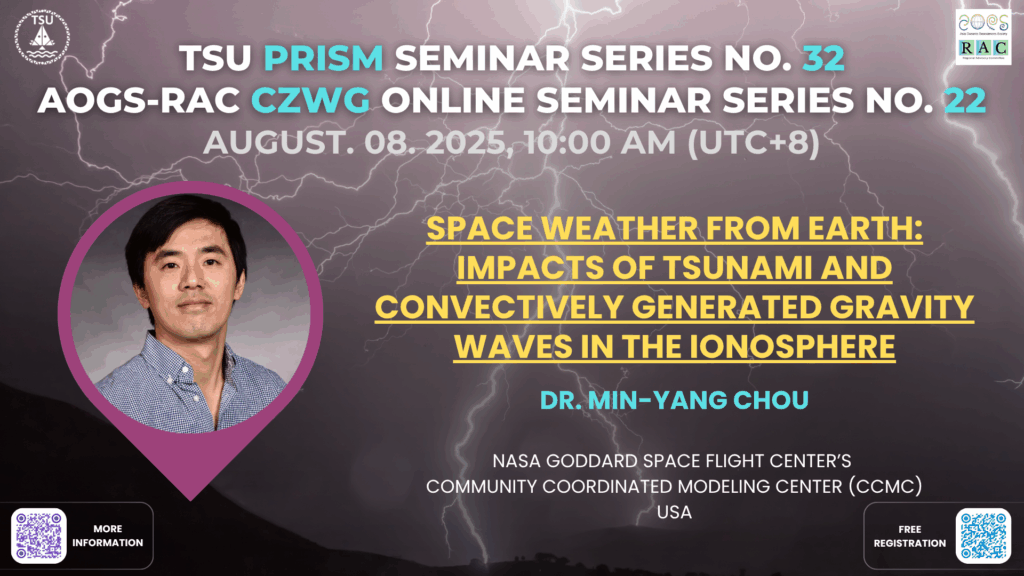
Date: August 8, 2025, 10:00 AM (UTC+8)
Speaker: Dr. Min-Yang Chou
Title: Space Weather from Earth: Impacts of Tsunami and Convectively Generated Gravity Waves in the Ionosphere
Biography
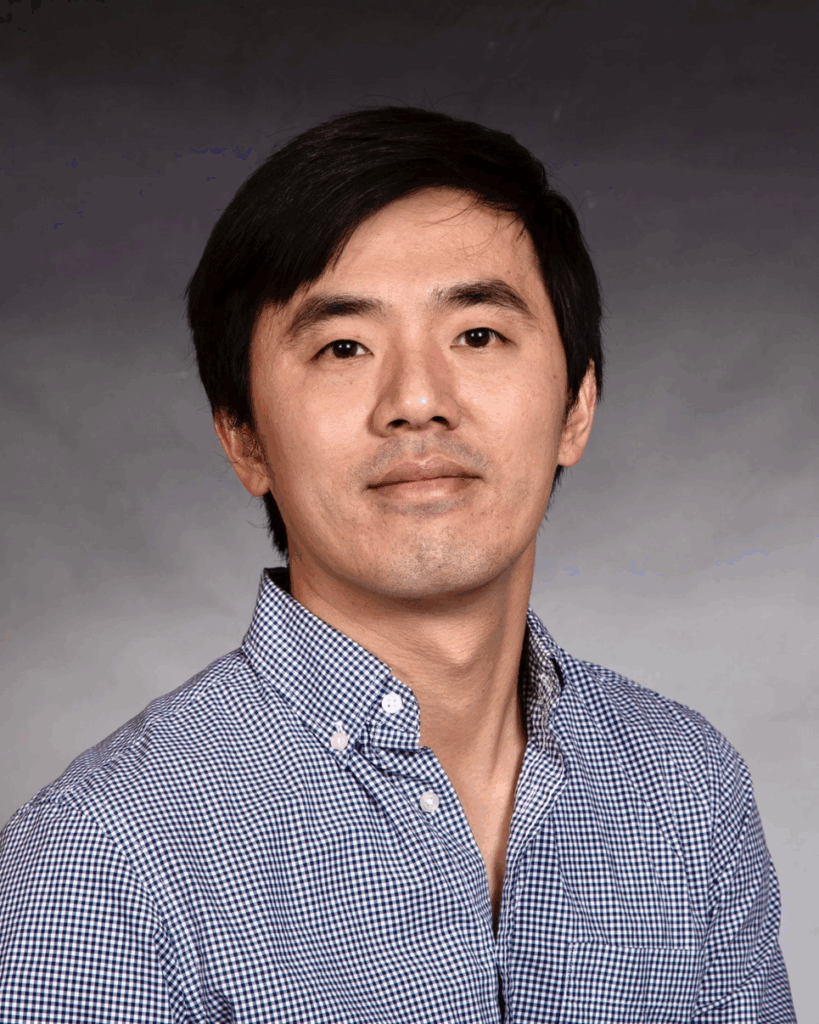
Min-Yang Chou is an Ionosphere-Thermosphere Domain Scientist at NASA Goddard Space Flight Center’s Community Coordinated Modeling Center (CCMC). He received his Ph.D. from National Cheng Kung University in Taiwan in 2018. Before joining NASA CCMC, he was a postdoctoral fellow at University Corporation for Atmospheric Research, COSMIC Program Office from 2019 to 2021. He has been involved in the Taiwan-U.S. joint satellite missions, FORMOSAT-3/COSMIC and FORMOSAT-7/COSMIC2, developing the first Taiwan ionospheric RO Processing System (TROPS) with TACC and TASA. His research focuses on understanding how atmospheric waves affect the ionosphere by using various ground-based, spaceborne satellite observations and numerical models. At CCMC, he is responsible for onboarding and maintaining ionospheric models for runs-on-request and instant run systems, supporting the broader scientific community and space missions. He also leads CCMC’s ionospheric model validation efforts.
Abstract
In this talk, I will present traveling ionospheric disturbances (TIDs) associated with the 2011 M9.1 Tohoku earthquake using ground-based GNSS TEC observations. The catastrophic Tohoku earthquake unleashed a powerful tsunami traveling across the Pacific Ocean and beyond. Part of the tsunami was reflected by seafloor topography, sending waves back toward Japan. The reflected tsunami waves excited gravity waves that propagated into the ionosphere, producing TIDs. Remarkably, these disturbances were observed not only over Japan but also simultaneously in the conjugate hemisphere over Australia, ~7000 km away, providing the first observational evidence of interhemispheric electrodynamic coupling triggered by a localized tsunami.
In addition to tsunami-induced gravity waves, gravity waves generated by terrestrial weather systems, such as thunderstorms and typhoons, play an important role on the development of equatorial plasma bubbles (EPBs), a major space weather phenomenon that disrupts radio communications and GNSS signals. Despite decades of study, the day-to-day variability of EPBs remains poorly understood. This study explores how gravity waves contribute to EPB formation using data from FORMOSAT-7/COSMIC-2 and NASA GOLD, and simulations from the coupled SAMI3/SD-WACCMX model.